All issues / Founding events / Issue 3 of 54
Moroni and the plates
The story of the angel and the plates grew in the telling. Early sources speak of a spirit or an unnamed angel; the name Moroni comes later, and the official history once printed the name as Nephi.
The claim as critics state it7 cited points
The record in order
- 1823The first visit, as later dated
- 1832Joseph's history: “an angel of the Lord”, unnamed
- 1833Willard Chase recalls Joseph Smith Sr. describing “a spirit”
- 1835Oliver Cowdery names the angel Moroni
- 1842The Times and Seasons history names the angel Nephi
What every camp accepts
- Joseph's 1832 account calls the messenger “an angel of the Lord” without a name.
- The name Moroni was in print by 1835, and in a hostile book in 1834.
- The 1842 Times and Seasons printing of Joseph's history named the angel Nephi; later editions read Moroni.
The full story
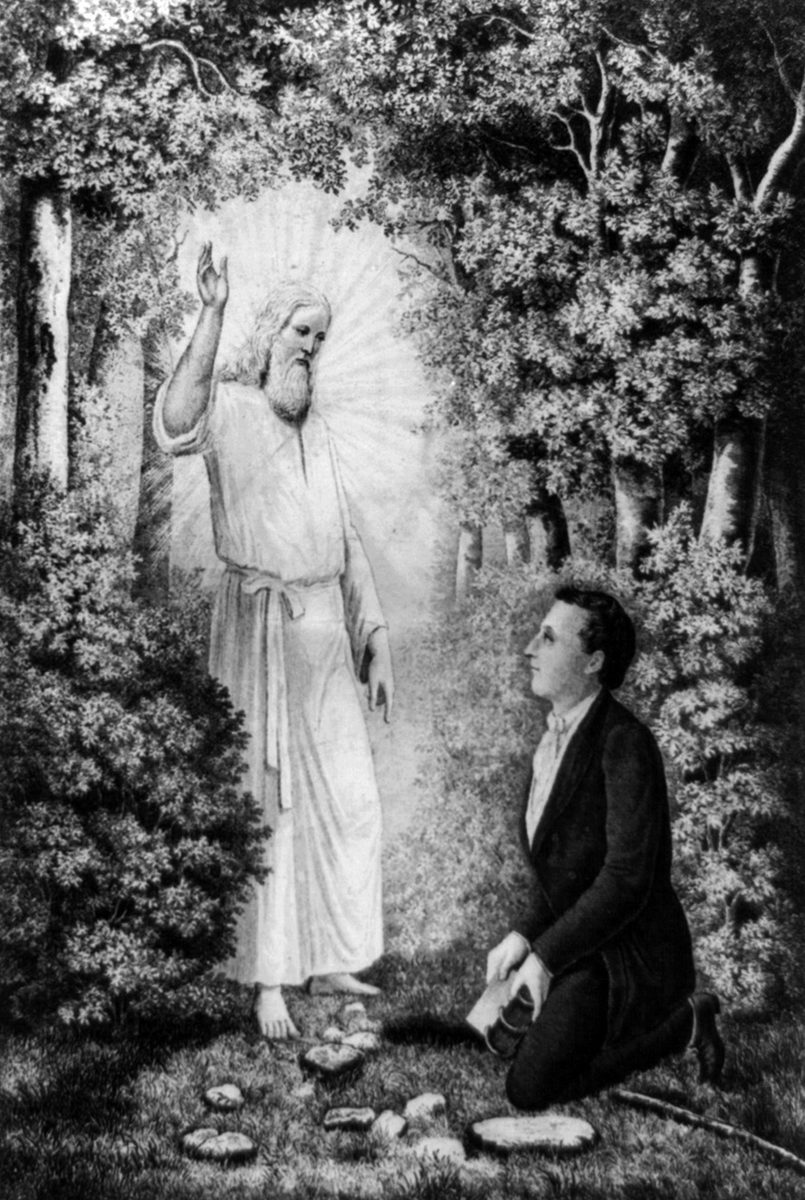
In the canonized account, an angel named Moroni, the last Book of Mormon prophet, appeared to Joseph Smith in his bedroom on the night of 21 September 1823. He told Joseph of a record on gold plates buried in a nearby hill. Joseph visited the hill each year for four years and received the plates in September 1827.
The earliest sources tell the story with less detail. Joseph's 1832 history speaks of "an angel of the Lord" without naming him, though it names "Maroni" as one of the men who engraved the plates. Neighbours who gave statements in 1833 remembered the Smith family describing a "spirit" that guarded a treasure. Some of these statements were collected by a hostile editor, Doctor Philastus Hurlbut, and defenders discount them for that reason. The name Moroni first appears in print in 1835, in Oliver Cowdery's letters on Church history and in a revised revelation.
The 1838 history that Joseph dictated, and its 1842 printing in the Times and Seasons, which Joseph edited, name the angel "Nephi". The name stayed in the 1851 first edition of the Pearl of Great Price. Later the manuscript was corrected to "Moroni" between the lines, and later editions use Moroni. Defenders call it a scribal slip carried into print. Critics point out that Joseph was editor of the newspaper and never corrected it in his lifetime.
The story also changed in the telling of the plates' recovery. Early accounts include a toad or other creature at the hill and a requirement that Joseph bring his dead brother Alvin. These details echo the treasure lore of the region and drop out of the official history. Historians of the Smith family's folk-magic world, including D. Michael Quinn, read the angel story as growing out of that background. Faithful historians describe a young man whose religious experiences came to him in the vocabulary his culture gave him.
Church and defenders
Church History topic, FAIR, Orson Pratt
The name came early and often. Moroni was in print years before 1842, even in the hostile Mormonism Unvailed (1834).FAIR
One scribal source. Every “Nephi” reference descends from one manuscript and its copies.FAIR; Church History topic, Angel Moroni
Many angels, easily confused. Joseph received many heavenly visitors; scribes writing from memory could mix their names.Orson Pratt
Critics
MormonThink, the Tanners
Joseph edited the paper. He was editor of the Times and Seasons when it printed “Nephi” and never corrected it.MormonThink, Moroni or Nephi?
The angel speaks of Moroni in the third person. In 1832 the angel names Moroni as the plates' engraver, not himself.Tanners, Falsification of Joseph Smith's History, p. 21
From treasure spirit to angel. The story moves from a guardian spirit to an unnamed angel to Moroni.MormonThink
Historians
John Whitmer Historical Association
An open scholarly question. Historians still debate whether Joseph first understood the being as an angel, a spirit or a treasure guardian.JWHA Journal 40:1, 2020
In their own words
Primary sources, quoted as written. Spelling and punctuation are the originals'.
He called me by name and said unto me that he was a messenger sent from the presence of God to me and that his name was Nephi.
he shewed unto me a heavenly vision for behold an angel of the Lord came and stood before me and it was by night and he called me by name and he said the Lord had forgiven me my sins and he revealed unto me that in the Town of Manchester Ontario County N.Y. there was plates of gold upon which there was engravings which was engraven by Maroni & his fathers
Disclosure and discipline
Documented instances of concealment, denial, quiet revision, attacks on critics and church discipline connected with this issue. Each has its source; where the Church has given its own account, it is beside it.
- Revised1842 to 1851, corrected later
Joseph's official history named the angel Nephi, and it was printed that way in the Times and Seasons, which Joseph edited, and in the first Pearl of Great Price. The name was later changed to Moroni in the manuscript and in print without notice to readers.
The Church's account: The Church and FAIR attribute "Nephi" to a scribal error, noting that Joseph named Moroni in other sources from 1835.
Times and Seasons 3:12 (15 April 1842), p. 753; Pearl of Great Price (1851); Tanners, The Changing World of Mormonism (1980)
Where it turns
On the Nephi slip alone the faithful explanation is strong. Did the larger story grow because memory clarified it, or because it was reinterpreted?
Check your reading: What name did the 1842 Times and Seasons give the angel?
Nephi. Earlier sources, and later editions, name him Moroni.
Read and listen
Primary sources
- Joseph Smith–History 1:27–54 (Pearl of Great Price)
- Dan Vogel, ed., Early Mormon Documents, vols. 1–5 (Signature Books, 1996–2003)
The Church
Critics
- MormonThink, "Moroni or Nephi?"
- Jerald and Sandra Tanner, The Changing World of Mormonism (Moody Press, 1980)
Historians
- D. Michael Quinn, Early Mormonism and the Magic World View, rev. ed. (Signature Books, 1998)
- Richard L. Bushman, Joseph Smith. Rough Stone Rolling (Knopf, 2005)
Podcasts
- Ep. 944–946: Joseph Smith's First Vision panel (Moroni or Nephi, from 56:08 in part 2)Mormon Stories Podcast
- Ep. 2026: Treasure digging and the First Vision, with John TurnerMormon Stories Podcast
Everything on one page: the library.