All issues / Founding events / Issue 1 of 54
The First Vision
Joseph Smith left several accounts of his first vision. They differ on who appeared, how old he was and why he prayed, and the canonized 1838 version was written eighteen years after the event.
The claim as critics state it10 cited points
The record in order
- 1820The date Joseph later gave for the vision, at age fourteen
- 1832His only handwritten account: he seeks forgiveness and sees “the Lord”
- 1835Told to a visitor: two personages and many angels
- 1838The canonized history: the Father and the Son; which church to join
- 1842The Wentworth letter: two personages
- 1965The Tanners publish the 1832 account
- 2013The Church's essay acknowledges the accounts
What every camp accepts
- There are at least four accounts from Joseph Smith's lifetime, written or dictated between 1832 and 1842.
- Only the 1832 account is in Joseph's own hand. It speaks of “the Lord” and of forgiveness of sins.
- The 1838 account, with the Father and the Son and the question of which church to join, is the one in the Pearl of Great Price.
- The Church's Gospel Topics essay on the accounts (2013) discusses the differences openly.
The full story
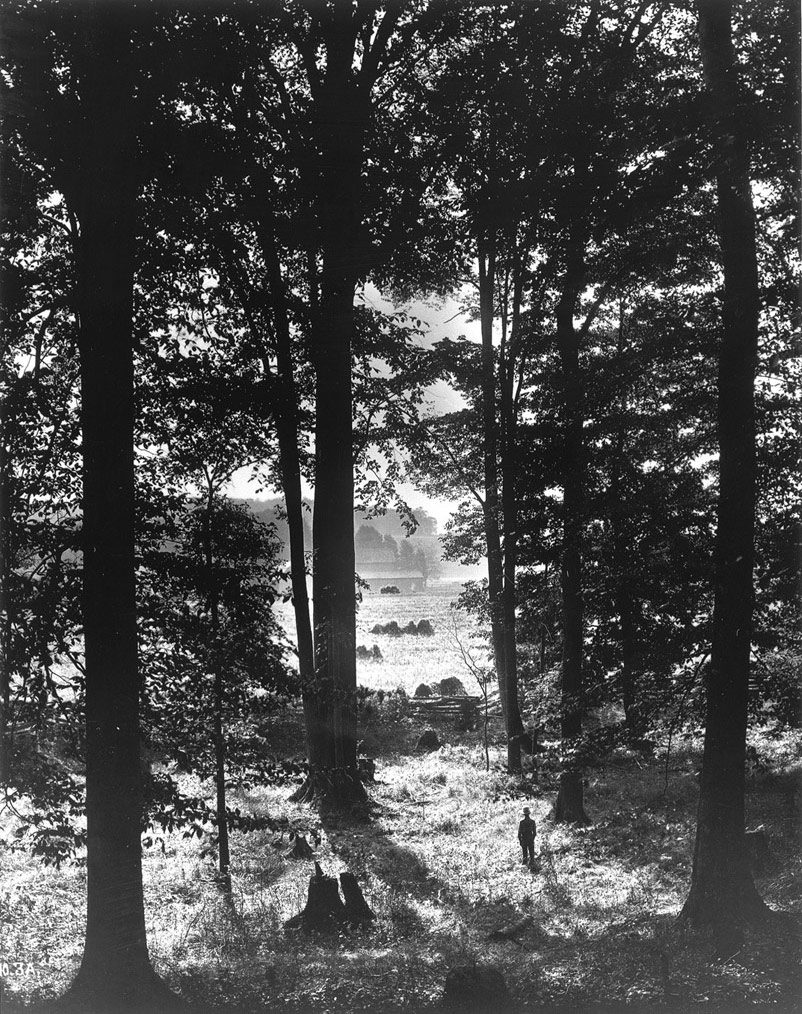
Today the First Vision is the Church's founding event. Missionaries teach it in their first lesson, and the Church presents it as the moment God the Father and Jesus Christ appeared to a fourteen-year-old boy in a grove near Palmyra, New York, in the spring of 1820, and told him to join none of the churches around him. That version comes from the history Joseph Smith began dictating in 1838, which was printed in the Times and Seasons in 1842 and canonized in the Pearl of Great Price in 1880.
The earliest surviving account is different. In 1832 Joseph began a short history, and the vision section is in his own handwriting. In it he is "in the 16th year of my age", he has already concluded from reading the Bible that the churches have apostatized, and he prays for forgiveness. "The Lord" appears in a pillar of light, tells him "thy sins are forgiven thee" and speaks of the world lying in sin. There is no second personage and no question of which church to join.
In 1835 Joseph told a visitor, Robert Matthews, that "a personage" appeared in a pillar of fire, then "another personage soon appeard like unto the first", and that "I saw many angels in this vision". In 1838 the account settles into its familiar form, and the 1842 Wentworth letter, written for a Chicago editor, also describes "two glorious personages". The first published account was Orson Pratt's 1840 pamphlet in Edinburgh, which gave the vision to the wider world.
Nobody disputes that the accounts exist or what they say. The Joseph Smith Papers publish all of them, and the Church's 2013 Gospel Topics essay discusses them openly. The disagreement is over what the differences mean. Defenders compare them to the three accounts of Paul's conversion in Acts and argue that each telling emphasised what mattered to its audience. Critics argue that the changes are too large to be the drift of memory. In their view, a private conversion experience of the kind common among revival converts was retold as a theophany once Joseph led a church that needed a higher founding authority.
Two further questions sharpen the debate. The first is the revival. In 1967 the Presbyterian minister Wesley Walters argued that the "unusual excitement on the subject of religion" Joseph described fits the Palmyra revival of 1824–25, not 1820. Latter-day Saint historians answered with evidence of regional revivals and an 1818 camp meeting. The second is silence. Historian James B. Allen showed in 1966 that the vision played almost no part in Church teaching or publications during the 1830s, and only became central later in the nineteenth century.
The 1832 account itself had a complicated custody. It sat in a letterbook in the Church's archives for more than a century and reached the public in 1965, in a BYU master's thesis by Paul Cheesman and in a pamphlet by Jerald and Sandra Tanner. Historians of every camp now treat it as the earliest and most important account, and they disagree only about how much weight to give it against Joseph's later tellings.
Church and defenders
Gospel Topics essay, FAIR, Richard L. Bushman
One story, told for different hearers. The essay reads the accounts as consistent, differing in emphasis and detail, as Acts tells Paul's conversion three ways.Gospel Topics essay, First Vision Accounts
The details can be harmonised. “The Lord” in 1832 does not exclude a second being, and the 1835 account already has the which-church question.FAIR, First Vision accounts
Memory grows. A young man first told it in the language of frontier revival, later in the language of a church he led.Bushman, Rough Stone Rolling, p. 40
The revival can be placed. Defenders read the “excitement” as regional, or point to an 1818 camp meeting.Richard Lloyd Anderson, via FAIR
Critics
CES Letter, the Tanners, Dan Vogel, Grant Palmer
The accounts conflict on essentials. A spirit, an angel, angels, Jesus, or the Father and Son; age fifteen or fourteen; four different motives.Runnells, CES Letter
No one mentioned it in the 1830s. No Church publication, letter or journal of the decade refers to the vision.Runnells, citing James B. Allen
The revival is the 1824 one. The details Joseph gives match the 1824–25 Palmyra revival; moving to 1818 concedes there was none in 1820.Vogel, First Vision series
The 1832 account sat unpublished. Critics printed it in 1965 and argue leaders had known of it for decades.Tanners, Strange Account, 1965
Historians
John G. Turner, Stan Larson
A core that is not in doubt. Turner sees “little reason to doubt” that the young man “sought, saw, and heard the Lord”; the visitation itself is a matter of faith.John G. Turner
The custody facts stand. Later historians confirm how the 1832 account was kept and when it came to light.Stan Larson, Dialogue, 2014
What members were told
Documented cases where Church leaders or Church publications withheld, altered or misstated the record on this question. Each one gives what was said or done, what the record shows, and the defence offered for it.
For more than a century the Church taught one account of the First Vision, the canonized 1838 version, and the earliest account was not available.
The 1832 account, the only one partly in Joseph Smith's own hand, was cut out of the letterbook it was written in and kept in the office safe of Church Historian Joseph Fielding Smith, probably from the 1930s. It reached the public only in 1965. Apologists at FAIR agree that it was cut out and kept in the historian's safe.
The defence: Defenders say the cutting was poor archival practice rather than concealment, and that Church employees helped publish the account in 1965.
Stan Larson, Dialogue 47:2 (2014), p. 71; FAIR, "Letter for My Wife Rebuttal, Part 4" (2023)
The Church's History of the Church presents Joseph's 1835 journal as saying he told a visitor about "my first vision".
The original 1835 journal entry says he told of "the first visitation of Angels, which was when I was about 14 years old". The wording was changed when the journal was copied into the official history.
The defence: FAIR argues that Joseph used "angel" loosely for heavenly messengers, so the editors clarified rather than changed his meaning.
Joseph Smith Journal, 14 November 1835; FAIR, "The first and second visitation of angels"
In their own words
Primary sources, quoted as written. Spelling and punctuation are the originals'.
a piller of light above the brightness of the sun at noon day come down from above and rested upon me and I was filled with the spirit of god and the Lord opened the heavens upon me and I saw the Lord and he spake unto me saying Joseph my son thy sins are forgiven thee.
a personage appeard in the midst, of this pillar of flame which was spread all around, and yet nothing consumed, another personage soon appeard like unto the first, he said unto me thy sins are forgiven thee, he testifyed unto me that Jesus Christ is the son of God; and I saw many angels in this vision I was about 14. years old when I recieved this first communication
When the light rested upon me I saw two personages (whose brightness and glory defy all description) standing above me in the air. One of them spake unto me, calling me by name, and said, (pointing to the other.) “This is my beloved Son, hear him.”
Disclosure and discipline
Documented instances of concealment, denial, quiet revision, attacks on critics and church discipline connected with this issue. Each has its source; where the Church has given its own account, it is beside it.
- Concealedabout 1930 to 1965
The three leaves holding the 1832 account, the only one in Joseph Smith's hand, were cut out of Letterbook 1 and kept in the office safe of Joseph Fielding Smith, then Church Historian and later Church President. They were not published until 1965, and then first by a BYU student and by critics, not by the Church.
The Church's account: The Church has not explained the removal. Its Joseph Smith Papers note that the leaves were cut from the volume without saying who removed them or why, and they now publish the account in full online.
Dialogue 47:2 (2014), p. 71; Jerald and Sandra Tanner, Joseph Smith's Strange Account of the First Vision (1965) - Revised1835 journal, later edited history
Joseph's 14 November 1835 journal says he received "the first visitation of Angels" at about fourteen. When the entry was copied into the official History of the Church, the words became "my first vision", which brought the record into line with the later canonized account.
The Church's account: Defenders, including FAIR, acknowledge the change and argue that early Saints used "angel" broadly enough to include deity.
FAIR, "Joseph Smith's 1835 accounts of the First Vision"
Where it turns
Did the story grow as memories of a real experience do, or did it grow because a growing church needed a higher founding authority?
Check your reading: Which account is in Joseph Smith's own handwriting, and who appears in it?
The 1832 account. It speaks of “the Lord” and of forgiveness of sins; the Father and the Son appear together in the later, canonized account.
Read and listen
Primary sources
- Joseph Smith Papers, "Primary Accounts of Joseph Smith's First Vision of Deity"All the accounts from Joseph's lifetime, with images of the manuscripts.
- Dan Vogel, ed., Early Mormon Documents, vol. 1 (Signature Books, 1996)
The Church
- Gospel Topics essay, "First Vision Accounts" (2013)
- Saints, vol. 1, The Standard of Truth (2018), chapter 2
Defenders
- Steven C. Harper, First Vision. Memory and Mormon Origins (Oxford University Press, 2019)
- Milton V. Backman Jr., Joseph Smith's First Vision (Bookcraft, 1971)
- FAIR, "Introduction to the Accounts of Joseph Smith's First Vision"
Critics
- Wesley P. Walters, "New Light on Mormon Origins from the Palmyra Revival," Dialogue 4:1 (1969)
- Jerald and Sandra Tanner, Joseph Smith's Strange Account of the First Vision (1965)
- Dan Vogel, Joseph Smith. The Making of a Prophet (Signature Books, 2004)
- Jeremy Runnells, CES Letter (2013)
Historians
- James B. Allen, "The Significance of Joseph Smith's 'First Vision' in Mormon Thought," Dialogue 1:3 (1966)
- Dean C. Jessee, "The Early Accounts of Joseph Smith's First Vision," BYU Studies 9:3 (1969)
- Richard L. Bushman, Joseph Smith. Rough Stone Rolling (Knopf, 2005)
- Christopher C. Jones, on Methodism and the First Vision, Journal of Mormon History 37:2 (2011)
Podcasts
- Ep. 1648: Joseph Smith's First Vision, with LDS DiscussionsMormon Stories Podcast
- Ep. 1976: A Mormon historian on First Vision problems, with Steven C. HarperMormon Stories Podcast
- Ep. 1934: Richard Bushman on the issues raised in the CES LetterMormon Stories Podcast
Everything on one page: the library.