All issues / Book of Mormon origins / Issue 57 of 65
Who wrote the Book of Mormon?
Since 1834 critics have proposed human authors for the Book of Mormon, among them Solomon Spalding, Sidney Rigdon, and Joseph Smith himself drawing on his surroundings. Believers hold that it is an ancient record translated by the gift of God.
The claim as critics state it3 cited points
The record in order
- 1812Solomon Spalding is said to have written a novel about ancient America, later called "Manuscript Found".
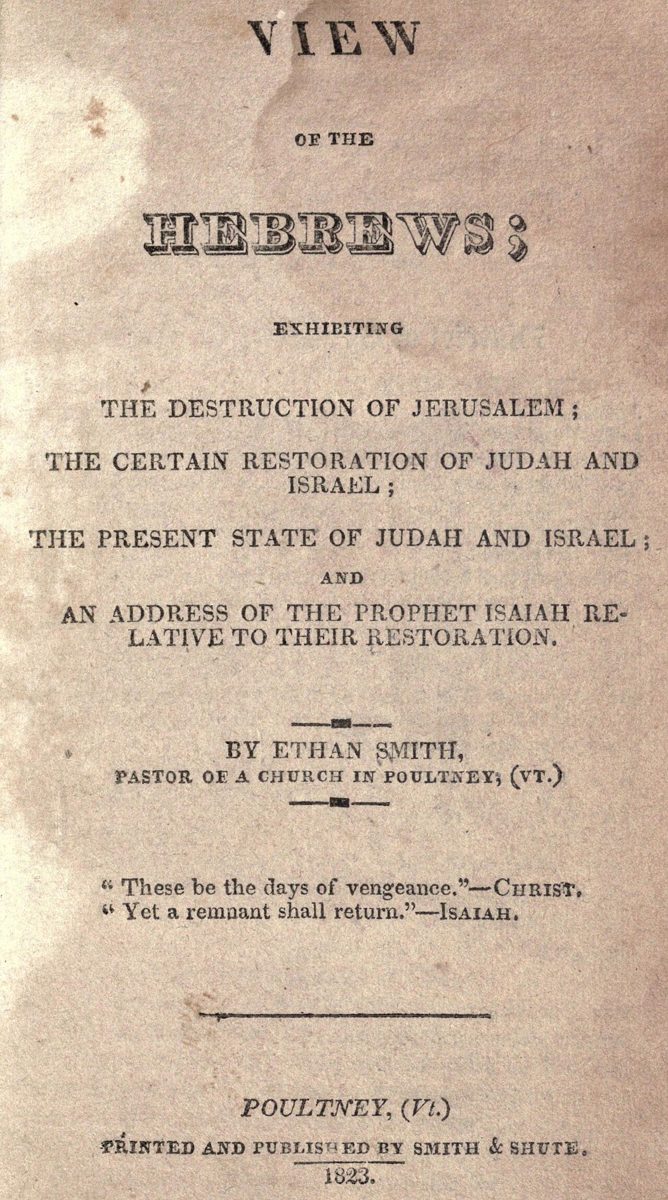
- 1823Ethan Smith publishes View of the Hebrews in Poultney, Vermont, arguing that Native Americans descend from the lost tribes.
- Apr–Jun 1829Joseph dictates most of the Book of Mormon in about three months.
- Nov 1830Sidney Rigdon joins the Church in Ohio, months after the book's publication.
- Dec 1833Philastus Hurlbut collects statements from Spalding's relatives and neighbours.
- 1834Eber D. Howe's Mormonism Unvailed publishes the Spalding theory and links it to Rigdon.
- 1884The Spalding manuscript is found in Honolulu and published. It does not resemble the Book of Mormon.
- 1922B. H. Roberts privately studies View of the Hebrews and the possibility that Joseph wrote the book from his imagination.
- 1945Fawn Brodie's No Man Knows My History argues that Joseph was the author.
- 1967John W. Welch identifies chiasmus in the Book of Mormon.
- 1980Wayne Larsen, Alvin Rencher and Tim Layton publish a stylometric study supporting multiple authors.
- 2008A Stanford-based stylometric study by Matthew Jockers and others supports Spalding and Rigdon. It is disputed by other statisticians.
- 2020William L. Davis publishes Visions in a Seer Stone, on oral composition.
What every camp accepts
- Spalding's surviving manuscript, found in 1884, is not the Book of Mormon.
- Most historians who are not believers now see Joseph as the author.
The full story
The first theory of the Book of Mormon's authorship appeared in 1834. Doctor Philastus Hurlbut gathered statements from relatives and neighbours of Solomon Spalding, a former minister who had died in 1816, saying that he had written a novel about ancient Americans with names like Nephi and Lehi. Eber D. Howe published them in Mormonism Unvailed and suggested that Sidney Rigdon had obtained the manuscript and passed it to Joseph.
In 1884 a Spalding manuscript was found in Honolulu and published. It is a short romance about Romans who sail to America, with little resemblance to the Book of Mormon. Spalding theorists argued for a second, lost manuscript, but most historians abandoned the theory, and the Rigdon link has never been documented before 1830.
Since Fawn Brodie's 1945 biography most non-believing historians have seen Joseph himself as the author, drawing on the King James Bible, the revivalism and politics of his region, popular ideas about Native American origins such as Ethan Smith's View of the Hebrews (1823), and his own gift for storytelling. Recent work by William Davis describes how a speaker trained in sermon "heads" could compose a long text aloud.
Believers hold that the book is a translation of an ancient record. They argue that its complexity, its internal consistency, the speed of its dictation in about three months without notes, and features such as chiasmus are beyond what a young man with little schooling could produce. Stylometric studies have been cited on both sides.
Church and defenders
FAIR, Interpreter
Beyond Joseph's ability. A young farmer with little schooling could not dictate so complex a book in under three months.Noel B. Reynolds, ed., Book of Mormon Authorship Revisited (1997)
Critics
Dan Vogel, Brent Metcalfe
Joseph's own work. The book reflects Joseph's world, and his gifts for storytelling and preaching explain it.Dan Vogel, Joseph Smith. The Making of a Prophet (2004)
Historians
William L. Davis
Oral composition. Joseph could have composed the book aloud using the techniques of sermon preparation of his day.William L. Davis, Visions in a Seer Stone (2020)
Where it turns
Does the speed and complexity of the dictation point to an ancient record or to a gifted composer?
Check your reading: Why did most critics abandon the Spalding theory?
Spalding's surviving manuscript, found in 1884, bears little resemblance to the Book of Mormon.
Read and listen
Primary sources
Defenders
- Noel B. Reynolds, ed., Book of Mormon Authorship Revisited (FARMS, 1997) Buy
- Lester E. Bush Jr., "The Spalding Theory Then and Now", Dialogue 10:4 (1977)
Critics
Historians
- Fawn M. Brodie, No Man Knows My History (Knopf, 1945) Buy
- William L. Davis, Visions in a Seer Stone. Joseph Smith and the Making of the Book of Mormon (University of North Carolina Press, 2020) Buy
- B. H. Roberts, Studies of the Book of Mormon, ed. Brigham D. Madsen (University of Illinois Press, 1985) Buy
Everything on one page: the library. As an Amazon Associate, the Open Stories Foundation earns from qualifying purchases made through "Buy" links.