All issues / Book of Mormon origins / Issue 56 of 65
The Anthon transcript
Martin Harris took characters copied from the plates to the scholar Charles Anthon, and Joseph's history says Anthon certified them before tearing up his certificate. Anthon said the story was "perfectly false".
The claim as critics state it3 cited points
The record in order
- Feb 1828Martin Harris visits Samuel Mitchill and Charles Anthon in New York with characters from the plates.
- Apr 1828Harris begins serving as Joseph's scribe and later mortgages his farm to fund printing.
- 1832Joseph's first history refers to the characters being shown to the learned, citing Isaiah.History, circa Summer 1832, Joseph Smith Papers
- 17 Feb 1834Anthon writes to Eber D. Howe that the story of his endorsement is "perfectly false".
- 1838Joseph's 1838 history says Anthon certified the translation, then tore up the certificate.
- 3 Apr 1841Anthon writes a second letter, to Thomas Coit, giving a partly different account.
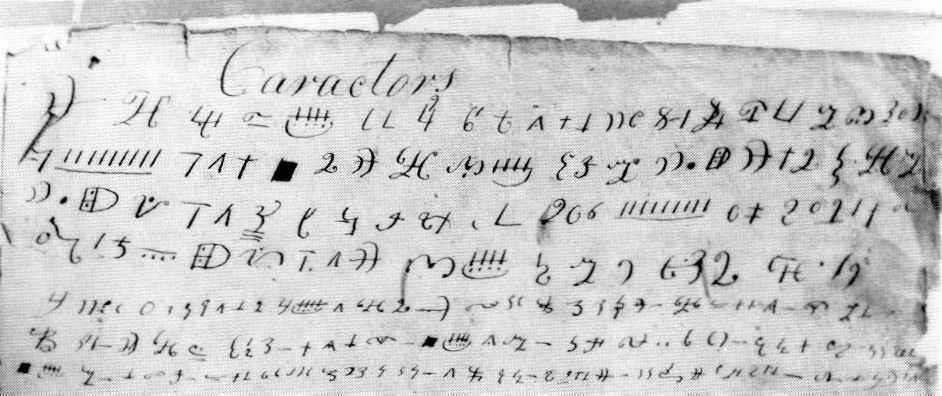
- 1903The RLDS Church acquires the "Caractors" document from the Whitmer heirs.
- Apr 1980Misstated Mark Hofmann sells the Church a forged Anthon transcript, which it announces as a major find.
- 1987The Hofmann transcript is exposed as a forgery after his confession.
- 2009The Joseph Smith Papers publishes the "Caractors" document.
What every camp accepts
- Martin Harris visited Charles Anthon in New York in early 1828.
- Anthon wrote in 1834 and 1841 that he had told Harris the characters were a hoax.
The full story
Early in 1828, with Joseph Smith dictating in Harmony, Martin Harris took a sheet of characters said to be copied from the plates to New York City. There he showed them to Samuel Mitchill and to Charles Anthon, a classics professor at Columbia College. Joseph's 1838 history says Anthon declared the characters and translation correct and wrote a certificate saying so, then tore it up when he learned of the angel. The history presents the visit as the fulfilment of Isaiah 29, where a sealed book is given to one who is learned.
Anthon told a very different story. In an 1834 letter to Eber D. Howe he said "the whole story" of his endorsement was "perfectly false". He said he had concluded the paper was a hoax, a jumble of Greek, Hebrew and other characters copied from a book, and that he had warned Harris against a scheme to cheat him. He wrote a second letter in 1841 with somewhat different details.
Harris returned home convinced and mortgaged his farm to pay for printing the Book of Mormon. Defenders argue that Anthon had reason to distance himself from the new religion, and point to the inconsistencies between his two letters. Critics note that no scholar then or since has read the characters, and that the Isaiah reading was applied after the fact.
A document known as the "Caractors" sheet, in a clerk's hand, survives and is held by the Community of Christ. In 1980 Mark Hofmann forged an "original" Anthon transcript, which the Church bought and announced. It was his first major forgery.
Church and defenders
FAIR
Anthon changed his story. Anthon's two letters disagree, and Harris came home convinced enough to fund the book.FAIR, "Anthon transcript"
Critics
MormonThink
No scholar endorsed it. Anthon flatly denied authenticating the characters, which no Egyptologist can read.Charles Anthon to E. D. Howe, 17 February 1834
Historians
Richard Bushman
Harris's real question. Harris was testing whether a learned man could read what Joseph could not, and saw Isaiah 29 fulfilled.Bushman, Rough Stone Rolling (2005)
In their own words
Primary sources, quoted as written. Spelling and punctuation are the originals'.
The whole story about my having pronounced the Mormonite inscription to be "reformed Egyptian hieroglyphics" is perfectly false.
Where it turns
Whose account of the visit is more credible, Anthon's or Harris's as Joseph told it?
Check your reading: What did Mark Hofmann forge in 1980?
A copy of the "Anthon transcript", which the Church bought.
Read and listen
Primary sources
- Charles Anthon to E. D. Howe, 17 February 1834, in Mormonism Unvailed (1834) Buy
- Joseph Smith–History 1:63–65
Defenders
- FAIR, "Anthon transcript"
Critics
- MormonThink, "Anthon transcript"
Everything on one page: the library. As an Amazon Associate, the Open Stories Foundation earns from qualifying purchases made through "Buy" links.