All issues / Doctrine and scripture / Issue 62 of 65
The Lectures on Faith removed
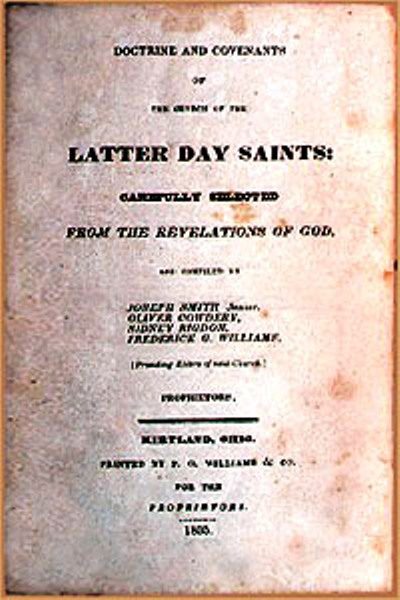
The Lectures on Faith were canonised in 1835 as the doctrine of the Doctrine and Covenants. They taught that the Father is "a personage of spirit". They were removed from the scriptures in 1921 without a vote of the Church.
The claim as critics state it3 cited points
The record in order
- Dec 1834The School of the Elders begins in Kirtland. The Lectures on Faith are delivered over the winter.
- 17 Aug 1835A general assembly accepts the Doctrine and Covenants, with the Lectures as its "doctrine" part.Doctrine and Covenants, 1835, Joseph Smith Papers
- 1841Joseph teaches that the Father has a body.
- Apr 1843Joseph's instruction now in D&C 130 says the Father has a body of flesh and bones.
- 1844The second edition of the Doctrine and Covenants keeps the Lectures.
- 1876Orson Pratt's edition keeps the Lectures.
- 1921Revised A committee of apostles removes the Lectures from the Doctrine and Covenants, saying they were never more than lessons.
- 1985Larry Dahl and Charles Tate publish a study edition of the Lectures through BYU.
- 1987Richard Van Wagoner, Steven Walker and Allen Roberts publish "The Lectures on Faith. A Case Study in Decanonization" in Dialogue.
What every camp accepts
- The Lectures were part of the Doctrine and Covenants from 1835 to 1921.
- Lecture Five describes the Father as a personage of spirit and the Son as a personage of tabernacle.
The full story
In the winter of 1834–35 Joseph Smith and other leaders taught a series of seven lectures on faith to the School of the Elders in Kirtland. When the Doctrine and Covenants was published in 1835, the Lectures formed its first part, the "Doctrine", and the revelations its second part, the "Covenants". A general assembly of the Church accepted the whole book as scripture.
The fifth lecture describes the Father as "a personage of spirit, glory and power" and the Son as "a personage of tabernacle", with the Holy Spirit as the mind they share. Later Latter-day Saint teaching holds that the Father has a body of flesh and bones and that the Holy Ghost is a separate personage. The Lectures remained in the Doctrine and Covenants for eighty-six years.
In 1921 a committee of apostles, chaired by George F. Richards and including James E. Talmage and Joseph Fielding Smith, removed them from a new edition. The edition's introduction said they had never been presented to or accepted by the Church as anything other than theological lessons. No vote of the Church was taken. The book stopped being called "Doctrine and Covenants of the Church of the Latter Day Saints" and the word "doctrine" lost its original reference.
Defenders note that Joseph may not have written the Lectures himself, that Sidney Rigdon likely composed much of them, and that they were always lessons rather than revelations. Critics answer that a conference accepted them as the Church's doctrine, that they were removed by a committee rather than a vote, and that the reason was their teaching on God. Historians treat the episode as a case study in how a canon is narrowed.
Church and defenders
FAIR
Never revelation. The 1921 committee removed them because they were lessons, not revelations, and were incomplete.Doctrine and Covenants, 1921 introduction
Critics
MormonThink
Removed for their doctrine. The Lectures contradict later teaching on the Father's body, which is why they were dropped.MormonThink, "Lectures on Faith"
Historians
Richard S. Van Wagoner, Steven C. Walker and Allen D. Roberts
Canon by vote, removed by committee. A conference accepted the Lectures as doctrine, but a committee of apostles removed them.Dialogue 20:3 (1987)
In their own words
Primary sources, quoted as written. Spelling and punctuation are the originals'.
They are the Father and the Son; The Father being a personage of spirit, glory and power: possessing all perfection and fulness: The Son, who was in the bosom of the Father, a personage of tabernacle, made, or fashioned like unto man
Disclosure and discipline
Documented instances of concealment, denial, quiet revision, attacks on critics and church discipline connected with this issue. Each has its source; where the Church has given its own account, it is beside it.
- Revised1921
The Lectures, accepted by a Church conference in 1835 as the Church's doctrine, were removed by a committee of apostles without a vote of the membership. The new edition said they had never been presented as anything but lessons.
The Church's account: The Church says the Lectures were never revelations and were incomplete in their teaching on the Godhead.
Doctrine and Covenants (1921), introductory explanation; Van Wagoner, Walker and Roberts, Dialogue 20:3 (1987)
Where it turns
Can a church remove from its scriptures what a conference once accepted as doctrine?
Check your reading: Who decided in 1921 to remove the Lectures on Faith?
A committee of apostles led by George F. Richards and James E. Talmage.
Read and listen
Defenders
- Larry E. Dahl and Charles D. Tate Jr., eds., The Lectures on Faith in Historical Perspective (Religious Studies Center, BYU, 1990) Buy
- Noel B. Reynolds, "The Case for Sidney Rigdon as Author of the Lectures on Faith", Journal of Mormon History 31:3 (2005)
Critics
- MormonThink, "Lectures on Faith"
Historians
- Richard S. Van Wagoner, Steven C. Walker and Allen D. Roberts, "The Lectures on Faith. A Case Study in Decanonization", Dialogue 20:3 (1987)
Everything on one page: the library. As an Amazon Associate, the Open Stories Foundation earns from qualifying purchases made through "Buy" links.